Speaker diarization: who said what in a customer call
Speaker diarization is the automatic splitting of a recording into segments and assigning each one to a specific person. It answers the question "who spoke when."

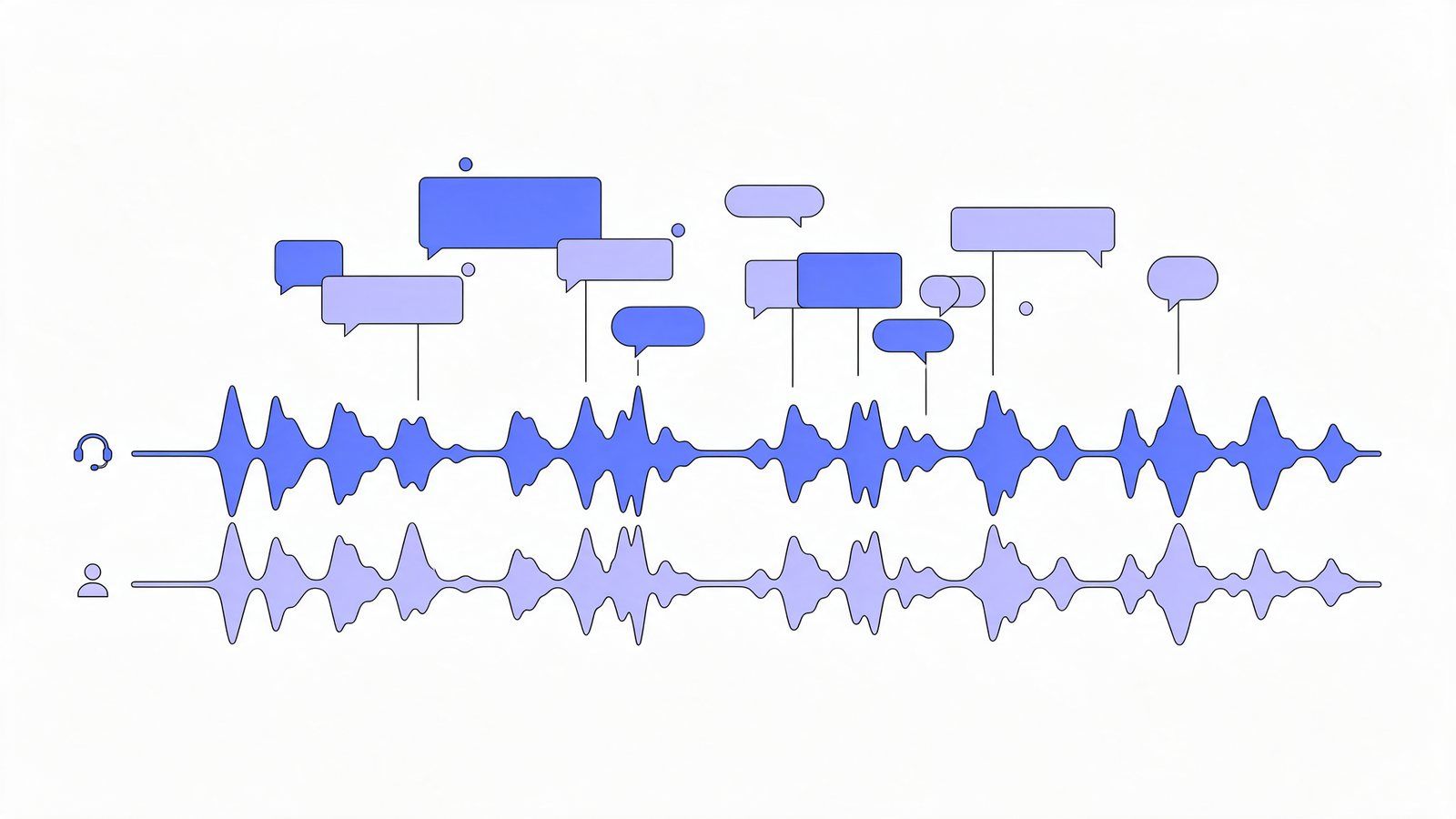
Speaker diarization is the automatic splitting of a recording into segments and assigning each one to a specific person. It answers the question “who spoke when.” Transcription tells you what was said; diarization adds who said it. Only together do they produce a record you can use to evaluate an agent’s work.
In customer calls, there are two ways to get there. If the phone system records the agent and the customer on separate channels, the task is almost trivial. If the recording is single-channel (mono), the system has to recognize speakers by their voices, and that’s where errors begin.
Key takeaways:
- Diarization = splitting a recording into segments assigned to speakers (“who spoke when”).
- Transcription answers “what was said”; diarization answers “who said it.”
- Diarization is anonymous: it distinguishes Speaker 1 from Speaker 2 but doesn’t determine who they are. That sets it apart from speaker identification and voice biometrics.
- The simplest and most reliable method in a call center is dual-channel recording: the agent on one channel, the customer on the other.
- With mono recordings, many models return speaker labels along with the transcript, but this isn’t reliable: they make mistakes with similar voices and when people talk over each other.
- Without diarization, you can’t check whether the agent said a mandatory statement or calculate who talked how much, which means you can’t evaluate the call reliably.
What is speaker diarization
Speaker diarization is a process in which a system automatically splits a recording into segments and assigns each one to one of the people taking part in the conversation. The name comes from diary, a log of who spoke and when.
What a transcript looks like after diarization
Without diarization, a transcript is a “wall of text”:
Good morning, my name is Anna, how can I help you? I'm calling about my September invoice,
the amount is wrong. I see, could you give me your customer number? Yes, it's 48213.
After diarization, each utterance has a speaker label and a timestamp:
[00:03–00:07] Speaker 1: Good morning, my name is Anna, how can I help you?
[00:07–00:12] Speaker 2: I'm calling about my September invoice, the amount is wrong.
[00:12–00:16] Speaker 1: I see, could you give me your customer number?
[00:16–00:18] Speaker 2: Yes, it's 48213.
In a call center, the last step is turning “Speaker 1” and “Speaker 2” into “Agent” and “Customer.” That’s the easiest part of the job: a large language model (LLM) that reads the whole call or a section of it can easily tell who introduces themselves with the company name and leads the conversation, and who is calling about their own issue.
Transcription vs diarization: what’s the difference
Transcription answers “what,” diarization answers “who and when”
Transcription turns speech into text; read more in what phone call transcription is. Diarization doesn’t change a single word of the content. It adds information about who is speaking. Many modern systems do both at once: they return the text, timestamps (sometimes accurate to a single word or even part of one) and a speaker label for each utterance.
Why segmentation matters more than the labels themselves
Naming the roles is easy. The hard part comes earlier: correctly splitting the recording into utterances. Take a passage in which the customer gives consent with a short “yes” while the agent is still finishing the sentence. If diarization attaches that “yes” to the agent’s utterance, the transcript looks like this:
Speaker 1: Do you consent to this call being recorded? Yes.
Speaker 2: All right, so how can I help you?
The agent “answers themselves,” and the customer’s consent is missing from the record. No language model can fix this, because the information about who actually said “yes” was lost at the diarization stage. For quality assurance, that’s a fundamental difference.
Diarization, speaker identification and voice verification: three different things
These terms often get mixed up, but they refer to different tasks:
| Diarization | Speaker identification | Voice verification (biometrics) | |
|---|---|---|---|
| Question | Who spoke when? | Which specific person is this? | Is this really that person? |
| Output | Speaker 1, Speaker 2 | ”John Smith” | yes / no |
| Determines identity | no | yes | yes |
| Biometric data | no | usually yes | yes |
Diarization: anonymous separation
Diarization distinguishes voices only within a single recording. It doesn’t compare them with any database and doesn’t know who the speakers are.
Speaker identification: assigning speech to a specific person
In a call center, we usually know the agent’s identity without any voice analysis; it comes from phone system data (who was logged in at the workstation). So diarization is enough to know which utterances belong to that agent.
Voice verification: confirming identity
Voice verification compares a voice against a previously stored voiceprint, for example when logging in to a bank’s hotline. That is processing of biometric data, which falls under separate, stricter rules. Read more in our article on the rules for recording customer calls. Anonymous diarization is not biometrics.
How to separate agent and customer: two methods
Method 1: dual-channel recording, an almost trivial case
Many phone systems can record a call on two channels (stereo): the agent’s voice on one, the customer’s on the other. Diarization then comes down to a simple rule: everything on the agent’s channel was said by the agent. There’s no need to analyze voices or guess. Each channel is transcribed separately, and the utterances are then merged into a single timeline.
An added benefit: when people talk at the same time, their words don’t get mixed up, because each lands on its own channel.
Two things to watch out for:
- Crosstalk: if the agent’s voice “leaks” onto the customer’s channel (for example, through echo), the same words appear on both channels. You can reduce it with filters that detect the quieter, delayed voice of the other party and mute it before transcription. We’re developing solutions like this at Inoro as well.
- Which channel belongs to the agent: this is usually a fixed phone system setting, and even if it isn’t, a language model can infer the roles from the content of the call.
Transcribing a single channel also has a small cost: the model doesn’t hear the other side of the conversation, so it has less context for recognizing words. More on this in our article on audio quality and transcription accuracy.
Method 2: voice-based speaker recognition in a mono recording
If the phone system stores the call on one channel, the system has to work out by itself where the speaker changes. It detects segments containing speech, describes each with voice features (timbre, pitch) and groups similar segments into “speakers.”
Many speech recognition models do this out of the box: in addition to text and timestamps, they return a speaker label for each utterance. There are also separate tools specialized in diarization alone. Finally, you still need to determine which speaker is the agent. A language model does this based on the content, and that task rarely causes problems. The problems are earlier errors: utterances cut in the wrong place or assigned to the wrong speaker.
This approach works, but it isn’t reliable. In our tests on Polish phone calls, utterances assigned to the wrong person occurred more often with mono recordings than with channel separation in most cases, several times more often for some models.
Methods compared
| Two channels | Voice-based recognition (mono) | |
|---|---|---|
| Assignment confidence | very high, derived from the channel | depends on the recording |
| Overlapping speech | no problem | a frequent source of errors |
| Similar voices | no problem | a frequent source of errors |
| Requirements | correct recording configuration in the phone system | none |
| Main risk | crosstalk between channels | confusing speakers |
What to do if your phone system records in mono
First, check whether dual-channel recording can simply be switched on. In many systems it’s a single setting. That configuration change often does more than switching AI vendors. If it can’t be done, you’re left with voice-based recognition, in which case it’s worth regularly checking a sample of calls to see whether roles are assigned correctly.
When diarization gets it wrong: typical errors
With mono recordings, the most common problems are:
Similar voices
Two people with a similar voice timbre, for example of the same gender and similar age, may be treated by the model as a single speaker, or their utterances may be assigned alternately.
Overlapping speech (crosstalk)
When the agent and the customer speak at once, their voices merge into a single signal in a mono recording. The model assigns that segment to one person or cuts off the other person’s words.
Short interjections: “mhm,” “yes,” “I see”
Short acknowledgments contain too little audio to recognize the voice reliably. Yet a customer’s “yes” can be crucial, for example as consent to contract terms.
More than two people
A transfer to another agent, a consultation with a supervisor, a three-way conference call or a family member next to the customer’s phone. Here even dual-channel recording isn’t enough, because two people speak on one channel.
Poor audio quality
Noise and interference make it harder to recognize not only words but also voices. More in our article on what lowers transcription accuracy.
Diarization quality is measured with DER (Diarization Error Rate): the share of recording time assigned to the wrong person, missed, or wrongly classified as speech. In call center practice, a simpler and more useful measure is the share of utterances assigned to the correct role: agent or customer.
Why diarization is a prerequisite for reliable automated call scoring
A scorecard doesn’t work without speaker labels
Automated call scoring (auto-QA) checks whether the agent introduced themselves, asked the right questions and delivered mandatory information. If the system doesn’t know who said what, it can credit the agent with something the customer said, or the other way around. Inoro scores 100% of calls after they end using scorecards tailored to each customer, and every one of them assumes you know who is speaking.
Metrics available only after diarization
- Talk ratio: how much of the time the agent talks versus the customer. In sales, an agent who talks for most of the call is a warning sign.
- Agent monologue: the longest stretch of speech without the customer.
- Interruptions: how often the agent cuts the customer off.
- Dead air: long pauses, for example when the agent is looking something up in the system.
Compliance: who said the required statement
In collections, sales or insurance, the agent must convey specific information. The statement “this call is being recorded” read out by the customer (for example, when repeating a question) doesn’t fulfill the obligation. Without diarization, the system can’t tell the difference.
Who promised what
“I’ll call you back tomorrow by noon” said by the agent is a company commitment that has to be kept. “I’ll pay on Friday” said by a customer in a collections call is a promise to pay that’s worth recording. The same words attributed to the wrong person lead to the opposite conclusion, which is why extracting agreements from a call only makes sense once you know who made them.
How to check whether your recordings are ready for diarization: a checklist
There’s no single configuration that fits every phone system. Before you choose a solution, it’s worth answering a few questions:
- Are the recordings dual-channel? This is basic information about every audio file, usually visible in the file properties.
- Is there crosstalk? If you can clearly hear the other side of the call when listening to one channel, you need to account for it.
- How often do transfers and conference calls happen? These are cases where no method is fully reliable.
- If the recordings are mono, can stereo recording be enabled? Often a single question to your phone system vendor is enough.
- How does a sample perform? Comparing the output with a listen to a dozen or so calls tells you more than any spec sheet.
You don’t have to do this alone. At Inoro, we go through these questions with you during deployment and tailor the setup to your recordings. A phone system that records clean stereo is configured differently from mono recordings with transfers between agents. We can adapt, among other things, how speakers are separated, how crosstalk is reduced and how roles are assigned to fit your calls. Inoro doesn’t record calls; it uses the recordings you already have, as a layer on top of your existing system.
What about free tools with speaker separation?
For a single recording, such as an interview, a meeting or a podcast, free and low-cost transcription tools with speaker separation are usually enough. You can review and correct the output by hand.
In a call center, the scale is different: thousands of calls a month that nobody will review manually. What matters is consistency, automatic retrieval of recordings from the phone system, correct assignment of agent and customer, and control over where the data goes. So the question isn’t “can a call be split by speaker,” but “can it be done reliably for every call.”
FAQ
What is speaker diarization?
Speaker diarization is the automatic splitting of a recording into segments assigned to specific people. It answers the question “who spoke when.” It distinguishes speakers anonymously, as Speaker 1 and Speaker 2, without determining their identity.
How does diarization differ from transcription?
Transcription turns speech into text, telling you what was said. Diarization adds to that text who spoke and when. Many systems perform both operations at once.
Does diarization recognize who the speaker is?
No. Diarization only distinguishes voices within a recording. Determining identity is speaker identification, and confirming identity by voice is biometric verification, which is subject to separate regulations.
How do you separate the agent’s and the customer’s voices in a recording?
The simplest way is to record the call on two channels: the agent on one, the customer on the other. Assignment then follows directly from the channel. With a single-channel recording, the system recognizes speakers by voice features, which is less reliable.
When does diarization get it wrong?
Most often with similar voices, when people talk at the same time, with short interjections (“mhm,” “yes”), when more than two people take part and with poor recording quality. Dual-channel recording eliminates most of these problems.
Can you automate call scoring without diarization?
Not reliably. Without knowing who said what, the system may attribute the customer’s words to the agent, can’t calculate talk ratio or interruptions, and can’t check whether the agent was the one who said a mandatory statement.
Want to score 100% of calls without manual listening?
Inoro analyzes all calls after they end, as a layer on top of your current phone system (Genesys, Avaya, Cisco, API or SFTP): automated scoring against scorecards, compliance checks, and extraction of contact reasons and agreements from calls. We process data in the EU, with no transfers outside the EEA, and deployment typically takes 1–2 weeks (longer for large organizations).