First Contact Resolution (FCR): definition, formula, improvement
FCR (First Contact Resolution) is a metric that shows what share of customer issues is resolved during the first contact, without the customer having to call or write again about the same matter.

FCR (First Contact Resolution) is a metric that shows what share of customer issues is resolved during the first contact, without the customer having to call or write again about the same matter. The formula is: FCR = (number of issues resolved on first contact / total number of contacts) × 100%. The hard part is not the formula. It is deciding what exactly counts as “resolved” and over what time window you check whether the customer came back. Those decisions determine whether your results are comparable from month to month.
Key takeaways:
- Formula: FCR = (issues resolved on the 1st contact / all contacts) × 100%
- Settle four things before measuring: the time window, the definition of “the same issue”, how internal transfers are treated, and the unit of count.
- Four measurement methods: post-contact survey, agent tagging, repeat-contact analysis in your data, and conversation content analysis. Each carries a different systematic bias.
- An easier starting point: begin by measuring the inverse of FCR, the repeat contact rate, calculated from hard data.
- FCR and AHT pull in opposite directions: aggressive targets for shorter calls lower the share of issues resolved the first time.
What is FCR and what does it really tell you about your call center?
FCR shows whether your team can close a customer’s issue within a single interaction, whether by phone, email or chat.
First contact resolution vs first call resolution: what’s the difference
First call resolution applies to phone calls only. First contact resolution is the broader term, built for omnichannel service: it also covers email, chat, mobile apps and social media. In practice the two terms are often used interchangeably.
Why FCR reflects the customer’s perspective, not efficiency
Most contact center metrics measure internal efficiency: how many calls an agent handled, how fast the queue was cleared. FCR is also calculated from operational data, but it is one of the few metrics that looks at the process through the customer’s eyes. For the customer, contacting you again about the same issue is the main source of frustration; for the company, it is an unnecessary cost. A high FCR therefore means savings and higher satisfaction at the same time.
How to calculate FCR: formula and example
The formula itself is simple. The difficulty lies in honestly isolating the issues that were actually closed.
The FCR formula
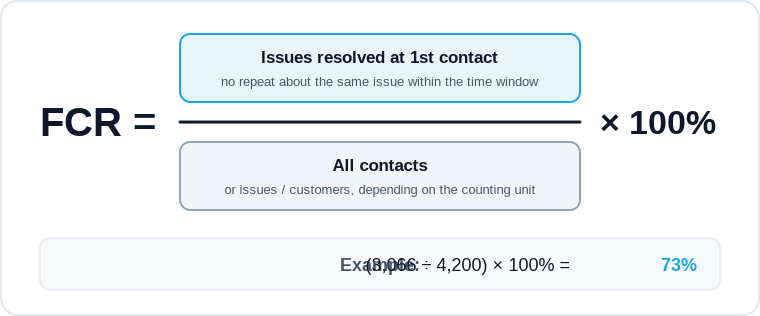
FCR = (number of issues resolved on first contact ÷ total number of contacts) × 100%
A worked example
In one month, a customer service department handled 4,200 contacts across all channels, of which 3,066 were resolved with no repeat contact:
FCR = (3,066 ÷ 4,200) × 100% = 73%
The remaining 27% are issues not closed the first time, which roughly corresponds to the share of repeat contacts. Roughly, because not every customer with an unresolved issue comes back; some simply give up.
Repeat contact rate as the inverse of FCR
Many managers start by measuring the inverse of FCR, the repeat contact rate:
Repeat contact rate ≈ 100% − FCR
A repeat contact is a hard fact in the logs: a call back from the same number or a new message from the same email address within a set time. “Resolved” is a judgment; a repeat contact is not. That makes it a more honest starting point, although matching by phone number alone has limitations, described below.
Four decisions to make before your first FCR measurement
Before you add FCR to your reports, settle four definitional questions. Without them, the metric won’t be comparable month to month and will be easy to game. We covered the most common mistakes that follow from skipping this in how to measure FCR properly.
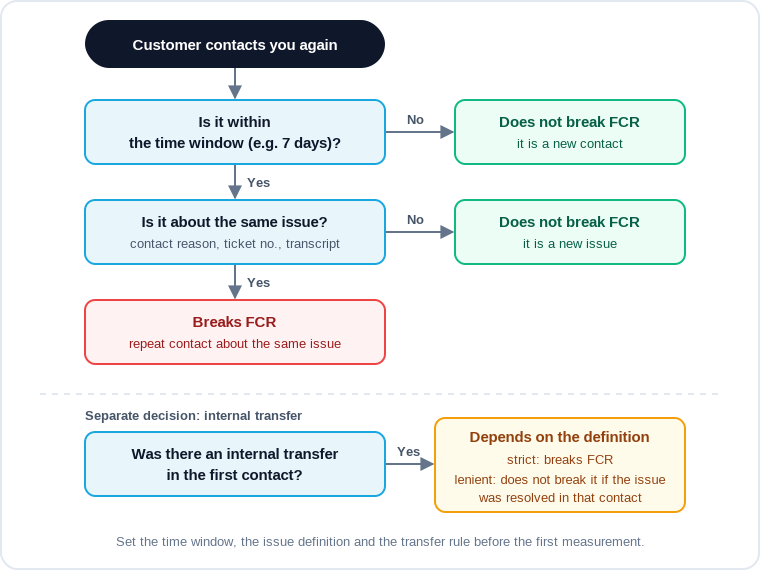
Time window: 24 hours, 3 days or 7 days
The window defines how long after the first contact a customer’s return is treated as a continuation of the same issue:
- 24–48 hours: simple transactional and e-commerce issues (order status, canceling an instruction).
- 3–7 days: subscription services, finance, telecom, where a system change takes time or requires action on the customer’s side.
- Rule of thumb: the longer the window, the lower the FCR, but the more honest the measurement.
What counts as “the same issue”
A repeat contact only counts when the customer comes back about the same topic. A return with a different problem should not lower FCR. You identify the same issue by:
- the contact reason code in your CRM (contact reason),
- the ticket ID,
- analysis of the call transcript (detecting the customer’s intent).
Matching only on caller number and timestamp can be misleading: different people in one household or company call from the same number, and the same customer can have two unrelated issues on the same day. So the number has to be combined with the contact reason.
Does an internal transfer break FCR?
That depends on your definition, and you need to choose it deliberately. A strict approach treats every transfer as an FCR miss, because the customer waits on the line and repeats the problem. A lenient approach treats the issue as resolved if it was closed within a single contact, even after a transfer. Consistency, plus measuring transfers separately, matters more than which option you pick.
Unit of count: contact, issue or customer
This decides the denominator of the formula:
- Per contact: each call or message is a separate record. Easiest to pull from the phone system.
- Per issue (ticket): contacts linked into one thread. Most realistic for written channels.
- Per customer: unique customers in the period. Mainly for narrow B2B customer bases.
FCR measurement methods in practice: pros, cons and limitations
There are four approaches, and each is affected by a different systematic bias.
Post-contact survey: asking the customer directly
After the interaction, the customer receives a question (by SMS, email or IVR): “Was your issue fully resolved?”
- Pro: the assessment comes from the person the issue concerned.
- Con: only some customers respond, and the rating of the resolution gets mixed up with the rating of the decision. A customer unhappy about a refusal will answer “no” even if the issue was closed.
- Use it: as a complement to hard data. More in how to measure call center service quality.
Agent tagging: the cheapest method, with a conflict of interest
After the call, the agent ticks a CRM field: “issue resolved on first contact”.
- Pro: the simplest and cheapest option in any system.
- Con: a conflict of interest. An agent evaluated on FCR is grading their own call.
- Use it: to get started, when no other data is available.
Repeat-contact analysis in telephony and CRM data
Contacts are linked automatically by customer identifier (phone number, email, customer number, tax ID) and timestamp.
- Pro: a repeat contact is a fact in the data, not someone’s opinion.
- Con: without contact reason codes, it’s hard to tell a return about the same issue from a new request.
- Use it: as the analytics foundation in larger teams.
Conversation content and transcript analysis (speech analytics)
Call transcripts and message content are analyzed automatically by language models (more in AI in the call center).
- Pro: the contact reason and the statement that the issue was resolved are detected in the conversation itself, not guessed from a code the agent picked. This solves the biggest problem of the data method: recognizing whether a return concerns the same issue.
- Con: it requires deploying a tool, and the result depends on transcript quality and the accuracy of intent detection.
- Use it: in high-volume teams that automate service quality assurance. For example, Inoro analyzes 100% of calls after they end and lets you group contacts into issues based on what the customer actually talked about (conversation intelligence). The tool provides the data to calculate FCR; you still set the time window and the definition of an issue.
FCR measurement methods compared
| Measurement method | Objectivity | Implementation cost | Main source of error | When to use |
|---|---|---|---|---|
| Post-contact survey | Medium | Low | Who responds; rating of the decision | To verify customer perception |
| Agent self-report | Low | Very low | Agent’s conflict of interest | To get started on no budget |
| Telephony and CRM data | High | Medium | Hard to tell issues apart | As the main operational metric |
| Conversation content analysis (AI) | High | Medium | Transcript and classification quality | At high call volume and with auto-QA |
What is a good FCR? Benchmarks vs reality
There is no single good value. FCR depends on the industry, issue complexity and the measurement rules you adopt.
Why rigid cross-industry benchmarks are misleading
Industry reports publish averages, but without information on industry, issue complexity and measurement method, such an average says little. A retail hotline where most questions are about parcel status will reach a different level than B2B technical support or complaints handling at a bank.
Why FCR depends on issue complexity and agent authority
- Issue complexity: the more simple requests self-service absorbs (password resets, bots, FAQs), the harder the ones that reach agents. FCR drops even though service as a whole works better.
- Agent authority (empowerment): if a discount, refund or complaint decision requires a manager’s approval, FCR will stay low regardless of the team’s skills.
How to set your own baseline
- Fix the measurement rules (window, issue definition, transfers).
- Measure FCR for 2–3 months without changing processes.
- Break the result down by issue category (contact reason) and product line.
- Set targets against your own history, not market averages.
Why do customers call a second time? Four groups of causes
Improving FCR starts with the causes of repeat contacts (root cause analysis), not with generic slogans. Each of the four groups requires a different response.
Agents lack decision-making authority
An agent can’t resolve an issue if procedures don’t allow it: they have rigid monetary limits (for example, they can’t issue a refund of even about €10), they need a supervisor’s approval, or they have to pass the issue to the second line (tier 2).
No access to information and fragmented systems
The agent switches between non-integrated systems (billing, CRM, inventory, ticketing). The result: incomplete information, pressure to end the call before gathering details, and no visibility into the customer’s earlier contacts in other channels.
Causes outside the service department
Customer service absorbs the consequences of other departments’ mistakes:
- Logistics: delays, incorrectly picked orders.
- Product: app bugs, unclear instructions.
- Billing: confusing invoices, incorrect charges.
- Marketing: vague promotion terms.
Communication causes and wrong assumptions
The issue is formally closed, but the customer comes back because they didn’t understand the solution, the agent used jargon, or the agent assumed the customer knew the next step (for example, clicking an activation link) and didn’t check.
Manually listening to a random 1–2% of recordings is not enough to diagnose these causes. Teams increasingly use transcript analysis (for example in Inoro), which pulls the reasons for repeat contacts out of the full set of conversations and lets you ask questions about them in natural language.
How to improve FCR: 7 corrective actions
Each of the actions below addresses one of the causes of repeat contacts.
-
Broaden decision-making authority (empowerment) Analyze which issues go to the second line or require a manager’s approval. A decision threshold for agents (for example, compensation of up to about €25 without approval) eliminates a whole category of issues that today, by definition, can’t be closed on the first contact.
-
Single customer view Combine history from the CRM, telephony and ticketing system in one interface, so the agent immediately sees what the customer wrote in chat two hours earlier.
-
An up-to-date knowledge base Short, process-oriented cheat sheets as the single source of truth. Every change to the offer or terms should reach the knowledge base before it is announced publicly.
-
Eliminate contact reasons at the source Regularly send product, logistics and marketing teams reports on which processes and website copy generate the most repeat inquiries.
-
Confirm understanding at the end of the call Instead of “Is there anything else I can help you with?”, the agent makes sure the customer knows what happens next (“You’ll get an email with a link within 15 minutes; please click it. Is that clear?”).
-
Coaching and auto-QA based on real repeat contacts Focus coaching on calls after which the customer called again. Auto-QA with scorecards lets you check across all recordings whether agents close out issues and confirm understanding.
-
Close the loop with the customer If an issue required internal investigation, the company should reach out first once it’s resolved, before the customer calls to ask about the status.
FCR and other metrics: what to watch out for
Maximizing FCR in isolation from other metrics can backfire.
FCR vs AHT: a tug of war
Average handling time (AHT) and FCR pull in opposite directions. Pressure for short calls leads to unfinished issues and customers calling back, while explaining an issue thoroughly lengthens AHT. After-call work (ACW) behaves the same way: skipping the confirmation email or CRM update shortens ACW, but the customer comes back with an unresolved issue.
Don’t set aggressive targets for both metrics at once. For example, if an extra 30 seconds in the first call saves a second call lasting several minutes, the total time spent serving the customer goes down, even though the AHT of the individual call goes up.
FCR vs transfer and escalation rates
A high transfer rate and escalation rate directly lower FCR. An organization that wants to resolve issues on the first contact has to move as many decisions as possible to the first line.
What FCR doesn’t show: quality and customer sentiment
FCR only tells you whether the customer came back within a given time window. It doesn’t measure whether they were satisfied with the decision (for example, a rejected complaint), what emotions came up during the call, or whether the resolution lasted. When pushed hard, it leads to issues being closed by force.
That’s why FCR should always be read alongside quality metrics and satisfaction scores. For broader context, see how to measure call center service quality and call center KPIs. Customer sentiment is measured by separate survey-based metrics such as CSAT, NPS and CES.
Frequently asked questions (FAQ)
What is FCR?
FCR (First Contact Resolution) is a metric that shows what percentage of customer issues is resolved during the first contact, without the customer calling, writing or chatting again about the same matter.
How is FCR calculated?
Divide the number of issues resolved on first contact by the total number of contacts in the period and multiply by 100%. For example, 3,066 resolved issues out of 4,200 contacts gives an FCR of 73%.
What is a good FCR?
There’s no single universal value. Simple e-commerce support will reach a noticeably higher FCR than B2B technical support or bank complaints. Instead of copying benchmarks, measure FCR for 2–3 months under fixed rules and set targets against your own result.
How do you measure FCR in practice?
There are four methods: a post-contact survey, agent tagging in the CRM, repeat-contact analysis in telephony data, or AI analysis of conversation content. The easiest start is the repeat contact rate from telephony and CRM data, then refining which returns concern the same issue.
What’s the difference between first call resolution and first contact resolution?
First call resolution applies to phone calls only. First contact resolution covers all channels: phone, email, chat, apps and social media.
Does a high FCR always mean good service?
No. A high FCR can result from pressure on agents who close tickets without actually resolving them. FCR only shows whether the customer came back, not whether they were satisfied, so it’s analyzed together with quality and satisfaction metrics.
Want to measure and improve FCR reliably in your team?
The biggest challenge in measuring FCR is recognizing whether a customer is coming back about the same issue. Inoro analyzes 100% of calls after they end and detects the contact reason in the transcript, which lets you group contacts into the same issue, with no manual listening and no guessing from CRM codes. Deployment as a layer on top of your existing phone system typically takes 1–2 weeks, longer for large organizations: Learn more about quality assurance with Inoro.