Call scorecard: how to build one that gives repeatable results
A call scorecard is the list of criteria used to evaluate an agent's call, together with scoring rules, weights and critical errors. A good scorecard is one where two people scoring the same call arrive at the same result.

A call scorecard is the list of criteria used to evaluate an agent’s call, together with scoring rules, weights and critical errors. A good scorecard isn’t the one with the most line items. It’s the one where two people scoring the same call arrive at the same result. That is achievable: write each criterion as a test with an unambiguous pass condition, score “not applicable” in the agent’s favor, and treat compliance failures as a gate rather than one weight among many.
Key takeaways:
- Size: 10–20 criteria in 4–5 sections, plus a separate list of 3–6 critical errors.
- Every criterion has a pass condition, a fail condition and a description of the “not applicable” case.
- Yes/no instead of a scale, unless you can describe every point on the scale with a test.
- “Not applicable” = full points, not zero.
- Test every scorecard change on the same set of calls before you roll it out.
What a call scorecard is and what it isn’t
A scorecard describes what must happen in a single call, what must not happen, and how much each of those things is worth. It’s the evaluator’s tool (whether that’s a team lead, a QA specialist or an automated scoring system) and, at the same time, the agent’s work standard. An agent who knows the scorecard knows what’s expected of them. An agent who gets a score without knowing the scorecard gets a verdict.
In practice, a scorecard plays three roles at once:
- a standard: it records how the company wants calls to go,
- a measure: it turns a call into a score you can compare across agents and over time,
- coaching material: it points to the specific moment in the call that needs to improve.
Call scorecard vs. quality score
A scorecard evaluates one call. A quality score is an aggregate: the average of an agent’s, a team’s or a whole center’s scores over a period. How to calculate and read a quality score, how many evaluations you need for it to be reliable, and why listening to 2% of calls is a lottery are covered in how to measure call center service quality. Here we go one level down: how to write the criteria so that a single score can be trusted. Without that, the aggregate is just an average of random numbers.
Call scorecard vs. performance review
These are two different things, even though both are sometimes called a “scorecard.” An HR performance review covers competencies and goals over a quarter or a year. A call scorecard covers what happened in a specific call and can be verified in the recording. Scorecard results can be one input to a performance review, but they shouldn’t replace it.
Scorecard structure: sections, weights and critical errors
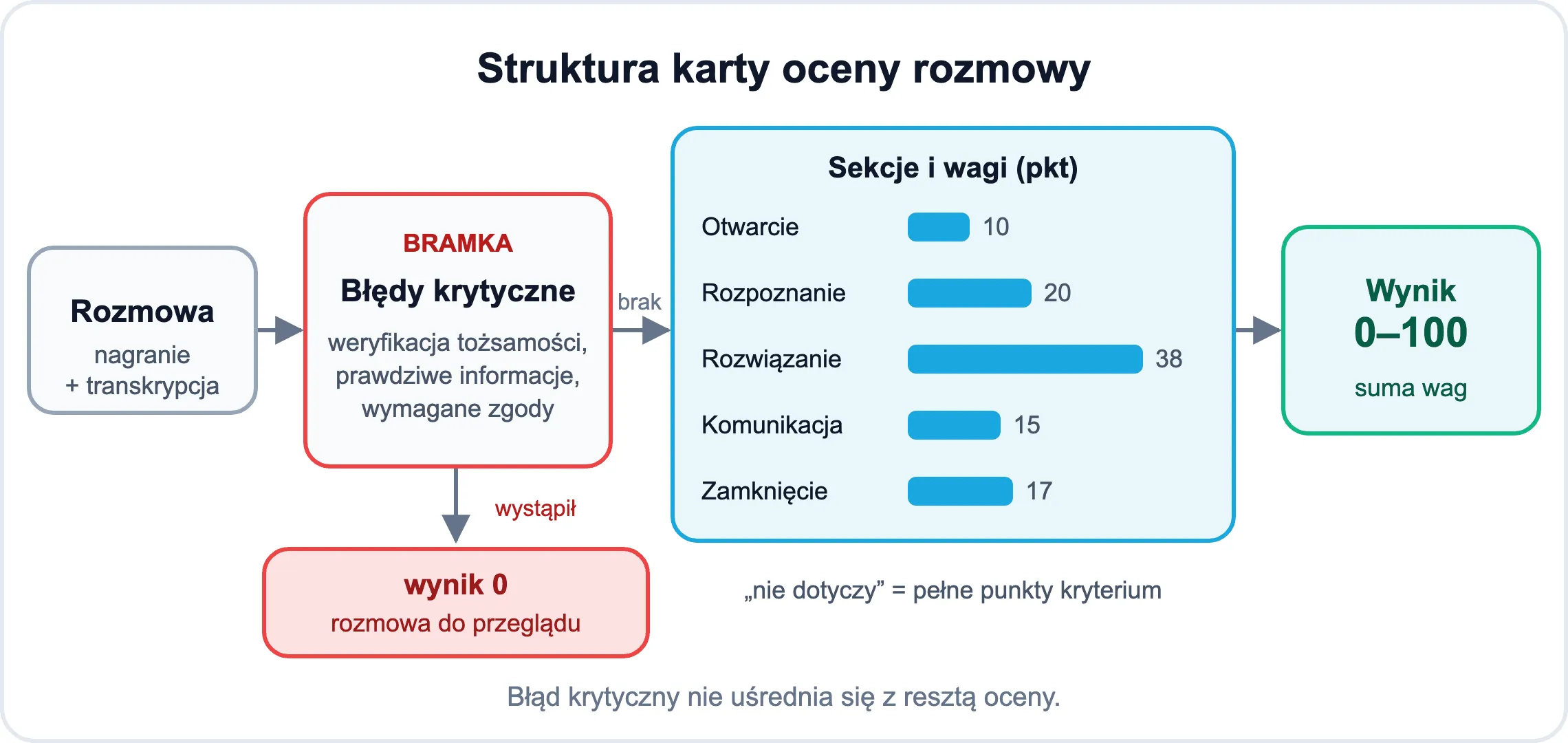
Sections: from opening to close
The clearest structure follows the flow of the call. Typical sections are:
- Opening: introduction, identification and verification of the caller.
- Discovery: understanding why the customer is calling and asking follow-up questions.
- Resolution: accuracy and completeness of the answer, correct procedure.
- Communication: clarity, tone, active listening.
- Close: summarizing what was agreed, next steps, checking whether the customer has other questions.
Ordering sections the way the call unfolds makes scoring easier, both for the person listening to the recording from start to finish and for the agent who reads the result and wants to find where they lost points.
How many criteria: why 10–20 and not 50
With several dozen items, three problems grow. The evaluator stops paying attention to every item and starts scoring “on impression.” Criteria start to overlap, so the same thing gets scored twice under different names. And each individual item weighs so little that the agent can’t tell what matters. The practical range is 10–20 scored criteria plus a separate, short list of critical errors. If a scorecard grows beyond 20 items, it usually means it’s combining several call types that should have separate scorecards, for example customer service and sales.
Weights: what counts more, and why it’s a business decision
Weights state what the company considers important. A support line measured on first contact resolution will give the “Resolution” section the highest weight. A sales team will give it to needs discovery and the offer. Weights should add up to 100 points, so the score can be read without any conversion. Avoid equal weights: a scorecard where introducing yourself counts as much as solving the problem tells the agent nothing about priorities.
Critical errors: a gate, not a weight
Some things shouldn’t be averaged with everything else. Sharing data without verifying identity, giving false information about contract terms, signing a customer up without the required consent: a call like that isn’t saved by the agent having been polite. That’s why critical errors work as a gate: if one occurs, the score is zeroed or the call is flagged for review, regardless of the points in the sections. If a critical error is just one criterion worth 10 points, a call with a serious violation can end up at 90/100 and disappear into the average.
Anatomy of a single criterion
Most scorecards look like this: “Agent identified the customer’s need – 0–10 pts.” That’s enough for the person who wrote it. For everyone else (a new team lead, a QA specialist from another team, an automated scoring system) it’s an invitation to interpret. A criterion should answer five questions.
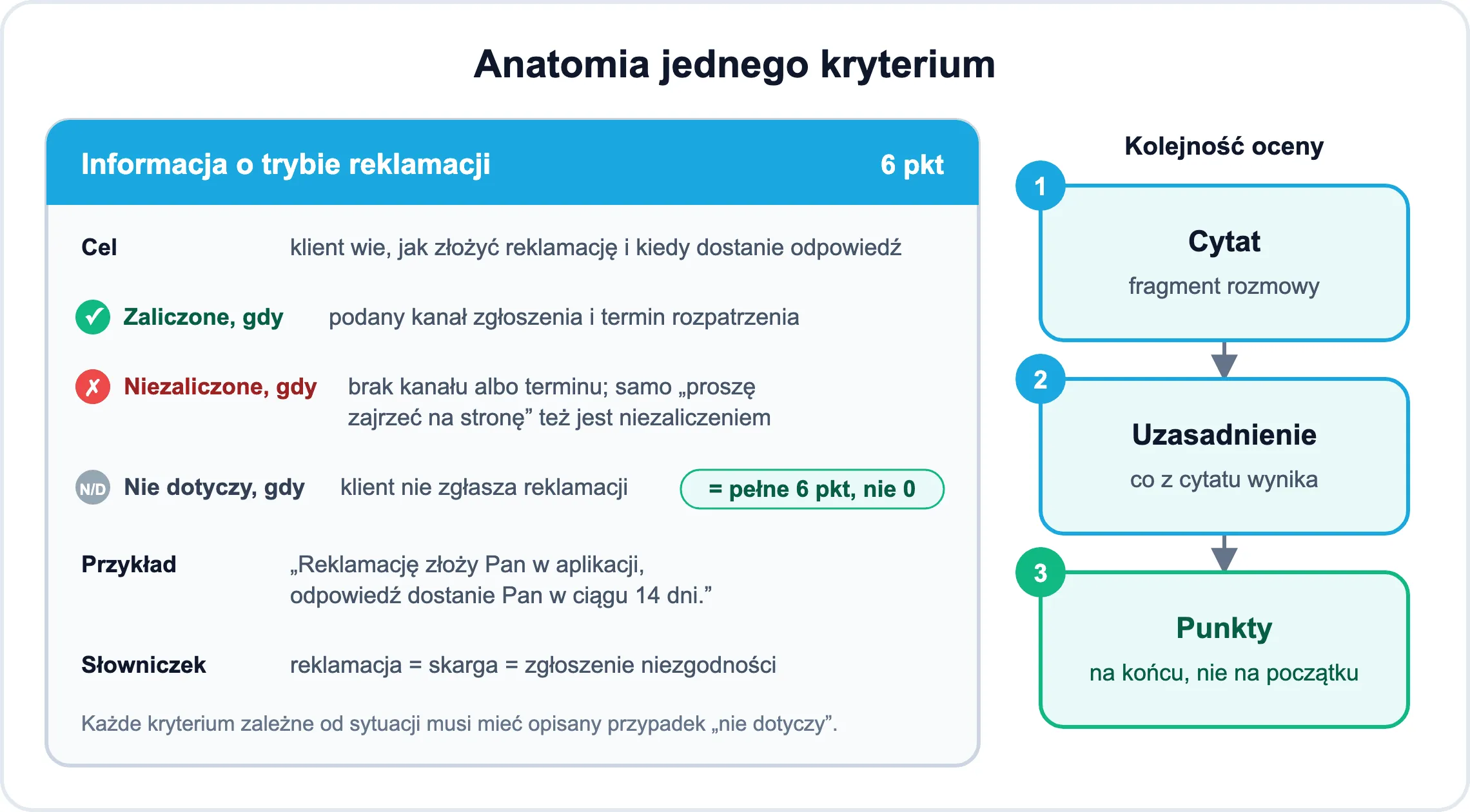
Pass and fail conditions
The pass condition describes what must be audible in the call for the criterion to be met. Not “the agent was empathetic,” but “the agent restated the customer’s problem in their own words before proposing a solution.” The fail condition is a separate sentence, not the negation of the first one, because there are usually in-between cases that need an explicit ruling. For example: does a paraphrase that distorts the customer’s problem count? If not, write that down.
”Not applicable”: when and how to score it
Every criterion that depends on the situation needs a defined “not applicable” case. The criterion “agent explained the complaint procedure” makes no sense in a call where the customer didn’t ask about a complaint. Such a call should get full points for that criterion, or the criterion should drop out of the denominator.
This is the most common silent error in scorecards. If “not applicable” turns into zero, the agent’s score depends on what customers called about, not on how the agent worked. Example: the complaint criterion is worth 10 points, and complaints come up in 30% of calls. If the criterion gives zero in the other 70%, the whole team’s average drops by 7 points, and nobody notices, because in any single evaluation it looks like ordinary missed points.
Allowed and disallowed examples, glossary
Two or three examples of phrasings that meet the criterion, and one or two that don’t, do more than a paragraph of description. Add a glossary too: if your industry has several ways of saying the same thing (“installment,” “monthly amount,” “what I pay every month”), the scorecard should say so explicitly. Otherwise the evaluator, especially an automated one, will treat them as different things.
Quote first, score second
The order of evaluation matters. An evaluator who enters the number first and the reasoning afterward fits the reasoning to the number. An evaluator who first points to a passage in the call, then writes what follows from it, and only at the end assigns points, is actually evaluating the call. This applies to people and to language models alike: in automated scoring we’ve seen comments that contradicted the score exactly when the form required the number before the reasoning.
A criterion template you can copy:
Criterion: [name]                                    Weight: [pts]
Purpose: [why we check this – one sentence]
Pass when: [what must be audible in the call]
Fail when: [what exactly counts as missing – edge cases described separately]
Not applicable when: [situation where the criterion doesn't apply → full points]
Pass examples: "…", "…"
Fail examples: "…"
Glossary: [synonyms used by customers and agents]
Scoring: quote from the call → reasoning → points
Yes/no or 0–10? Why middle values are a coin toss
A 0–10 scale looks more precise than yes/no. In practice it’s more precise only when every point on the scale has a defined condition. If the scorecard says “10 pts – full discovery, 5 pts – partial, 0 pts – none” but doesn’t say how “partial” differs from “full,” every evaluator draws that line in a different place.
This is very visible in automated scoring, because you can score the same call several times with the same scorecard. While calibrating one scorecard in Inoro, the same call got 90 and 79 points in two runs. The binary criteria gave the same answer in both runs. All of the spread came from the 10/5/0 scales and from “not applicable” rules left to the evaluator’s discretion. Once each point on the scale was given an unambiguous condition, the two runs produced identical scores.
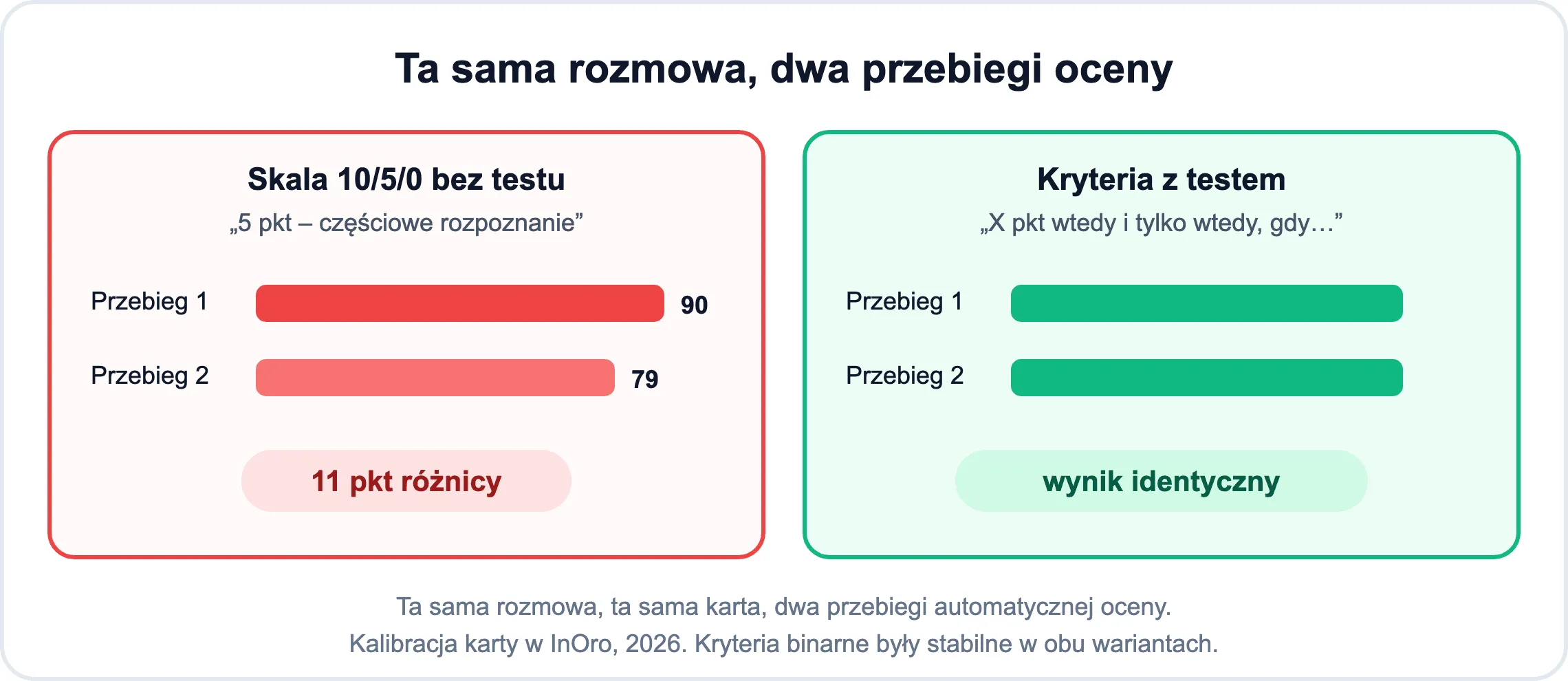
With human evaluators the same effect is larger, just harder to measure: two people scoring the same call typically differ by 10–20 percentage points.
The “X points if and only if…” test
Every point on a scale should be expressible as a sentence: “Award 5 points if and only if…”. Example for the “Needs discovery” criterion:
- 10 pts if and only if the agent asked at least one clarifying question and, before proposing a solution, restated what the customer needs.
- 5 pts if and only if the agent asked a clarifying question but proposed a solution without confirming the need.
- 0 pts in all other cases.
When a scale makes sense
A scale makes sense where the levels can be described by observable behavior, as above. Where you can’t write a test (“the tone was appropriate”), it’s better to drop to yes/no and define what counts as a fail (“the agent raised their voice,” “interrupted the customer more than once”). A simple criterion scored the same way every time beats a subtle one scored differently every time.
Six mistakes that break a scorecard
These patterns come up again and again when calibrating scorecards across industries. Each one means the score stops measuring the agent’s work.
-
A conditional requirement read as unconditional. Before: “If the customer gives details that don’t match the contract, ask for the customer number.” The evaluator penalizes the missing question in every call. After: “Asking for the customer number is required if and only if the customer gave details that don’t match the contract. Not asking in other calls is not an error.”
-
The criterion requires data the evaluator doesn’t have. Before: “Agent verified the address against the customer record.” The evaluator can’t see the record, so they judge whether the customer sounded confident. After: “Agent asked for the address and confirmed it with the customer. We do not assess whether it matches the record.” State explicitly what the scorecard doesn’t verify, and give an observable substitute.
-
A counterintuitive rule gets reversed. Before: “Agent offers the full amount first.” The evaluator sees this as a lack of flexibility and deducts points. After: stated explicitly: “Offering the full amount first is correct, even if the customer immediately asks for installments. Don’t deduct points for not offering installments in the first sentence.”
-
Vocabulary without mapping. Before: the criterion talks about an “installment,” the customer about the “monthly amount,” the agent about “what’s due.” The evaluator counts three different things. After: a glossary of synonyms attached to the criterion.
-
Trigger words penalized without context. Before: every use of the words “court,” “termination” or “penalty” is treated as pressure. After: a list of allowed phrasings (“I’m informing you that if payment isn’t made, the case may be referred to court”) and a test: is the agent describing a possibility or threatening a certainty? One criterion can’t call a threat what another criterion requires the agent to say.
-
Score before reasoning. Before: a form with the “score” field at the top and “comment” at the bottom. After: the order quote → reasoning → score, enforced by the form layout.
Template: customer service call scorecard
The template below is a starting point for a customer service line. Weights add up to 100 points. Before use, each criterion should be written out following the template in “Anatomy of a single criterion.”
Critical errors (gate: any occurrence zeroes the score and flags the call for review):
| # | Critical error |
|---|---|
| C1 | Sharing data or account information without verifying the caller’s identity |
| C2 | Giving false information about contract terms, fees or deadlines |
| C3 | Changing a service or signing a contract without the customer’s required consent |
| C4 | Abusive behavior toward the customer |
Scored criteria:
| # | Section | Criterion | Weight | ”Not applicable”? |
|---|---|---|---|---|
| 1 | Opening | Introduction with first name and company name | 3 | no |
| 2 | Opening | Caller verification according to procedure | 7 | yes – when the matter doesn’t require account access |
| 3 | Discovery | Clarifying question about the problem | 8 | no |
| 4 | Discovery | Confirming the customer’s problem before resolving it | 7 | no |
| 5 | Discovery | Checking the contact history on this matter | 5 | yes – first contact |
| 6 | Resolution | Resolution follows procedure | 12 | no |
| 7 | Resolution | Complete resolution: the customer doesn’t need to call back | 12 | no |
| 8 | Resolution | Information on timing and how it will be handled | 8 | yes – matter closed during the call |
| 9 | Resolution | Information on the complaint procedure | 6 | yes – no complaint |
| 10 | Communication | Clear language, no internal jargon | 6 | no |
| 11 | Communication | Not interrupting the customer | 5 | no |
| 12 | Communication | Announcing pauses in the call (searching, hold) | 4 | yes – no pauses |
| 13 | Close | Summary of what was agreed | 7 | no |
| 14 | Close | Asking about other matters | 5 | no |
| 15 | Close | Proper call closing | 5 | no |
| Total | 100 |
How to adapt the template to other call types
- Sales: shift weight from “Resolution” to needs discovery and an offer matched to the need; add a criterion for presenting the offer terms and, as a critical error, closing a contract without presenting the key terms.
- Collections: the scorecard needs two axes: effectiveness (promise to pay, amount, date) and compliance (identification, no pressure, no disclosure of the debt to third parties). A ready-made two-axis template is in our article on speech analytics in debt collection.
- Technical help desk: more weight on diagnosis (criteria 3–5) and on the correctness of instructions; close with confirmation that the problem is gone.
The scorecard in automated scoring: what a language model changes
Automated scoring lets you apply the scorecard to every call, not just the 1–2% sampled for listening. The differences between the classical approach and auto-QA are covered in Auto-QA vs classical QA. From the scorecard’s point of view, one thing changes, and it matters more than it seems.
The model reads the scorecard literally
An experienced evaluator “knows what the author meant” and quietly fills in imprecise wording with their own knowledge. A language model does exactly what is written, and where the wording is unclear, it fills the gap with general knowledge of how a call “should” go. That’s the source of all six mistakes described above: each of them exists in manually scored scorecards too, but automated scoring exposes them faster, because it covers thousands of calls at once and makes them measurable. That’s good news: a scorecard fixed for automated scoring is better for people as well.
In Inoro, we carry over the client’s existing scorecard without simplifying it into a few generic categories. Every point awarded has a rationale tied to a passage in the transcript, so the agent and team lead see not just the score but the moment in the call it comes from. Scoring happens after the call ends, on all recordings from the existing phone system. The quality team marks scores as correct or corrects them, and those approvals build the baseline we use to test every subsequent scorecard change.
One source of truth: reports calculated from criteria
If the same fact (for example, “did the agent offer an additional service”) is determined twice, once in the scorecard and once separately for a report, sooner or later the two answers will diverge. The agent gets points for the offer, and the report lists them among those who didn’t offer. The rule: reports and dashboards read the result from the scorecard criterion instead of recalculating it.
How to change the scorecard without breaking your results
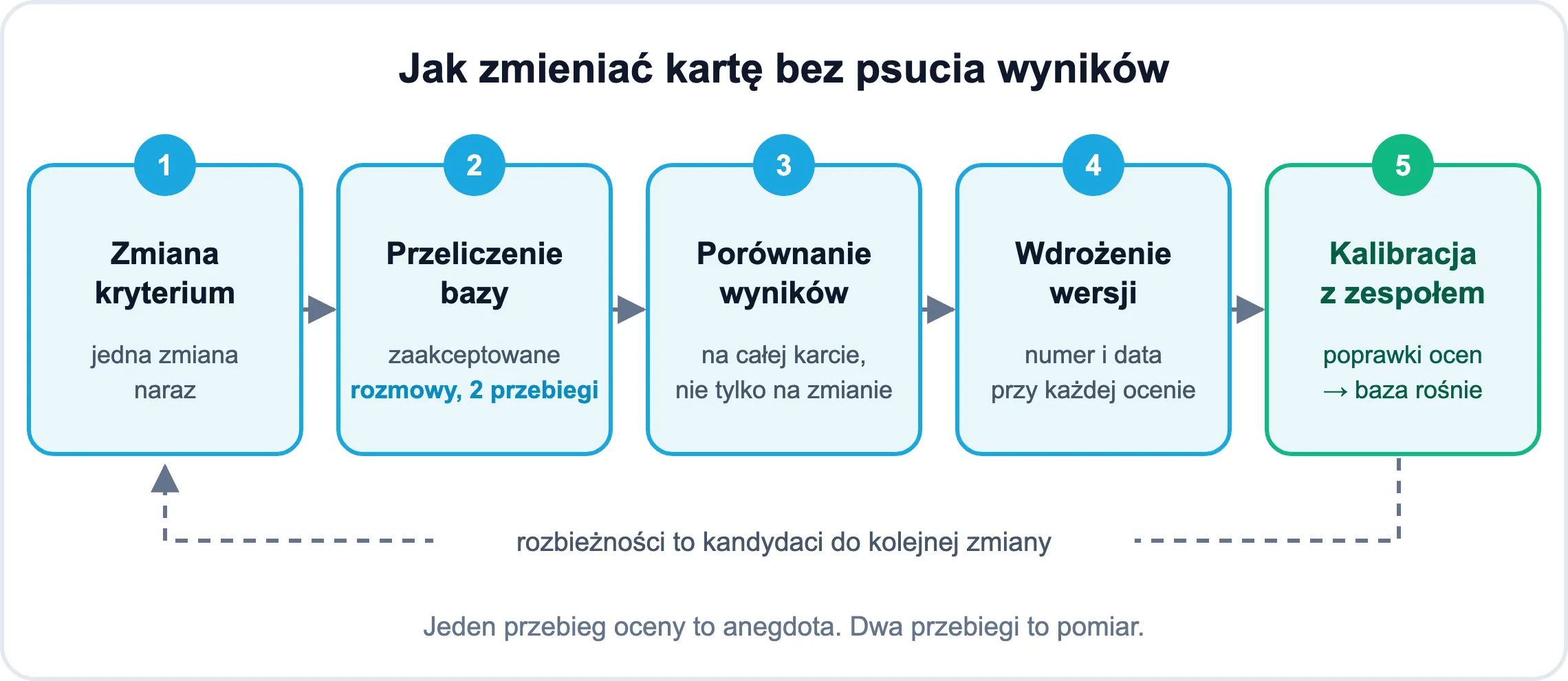
Scorecards change: new products arrive, procedures change, calibration reveals criteria that people interpret differently. But every scorecard change shifts the results, including historical comparisons. That’s why changes should be introduced the way software changes are: with a version and a test.
Versioning and a baseline of approved calls
Every scorecard version has a number and an effective date, and every score records which version produced it. Without that, a drop in results in a given month could mean the team’s work got worse or that one criterion got stricter, and there’s no way to tell which.
To test changes you need a reference baseline: a few dozen calls whose scores the quality team has reviewed and approved. Every new scorecard version is run against this baseline first and compared with the approved scores. One important rule when building the baseline: a score with a visible error gets corrected first and approved second. An approved error becomes part of the baseline and corrupts it exactly when you need it.
Two runs before drawing conclusions
In automated scoring, every change is measured with at least two runs per call. Otherwise the natural spread of scores masquerades as the effect of the change. Long scorecards carry one more risk: they can become “saturated,” where a small change in one criterion moves the results of unrelated criteria. That’s why it’s worth introducing changes one at a time and measuring each across the whole scorecard, not just the criterion you changed.
The scorecard is half the system. The other half is the process around it: who scores, how calibration works within the team, how an agent can appeal a score, and how results feed into coaching. We describe it in our article on the call quality assurance process, step by step.
Frequently asked questions (FAQ)
What should a call scorecard include?
A list of critical errors, 10–20 scored criteria grouped into sections that follow the flow of the call, weights adding up to 100 points and, for each criterion, a pass condition, a fail condition and a description of the “not applicable” case. Plus a version number and an effective date.
How many criteria should a scorecard have?
Usually 10–20 scored criteria and 3–6 critical errors. With more, criteria start to overlap and the evaluator stops paying attention to each one. If your scorecard grows beyond 20 items, check whether it’s combining several call types that should have separate scorecards.
How do you score a criterion that doesn’t apply to the call?
Award full points or exclude the criterion from the denominator. Never zero: otherwise the agent’s score depends on what customers called about, not on their work. Every situation-dependent criterion must have its “not applicable” case described in the scorecard.
0–10 scale or yes/no: which should I choose?
Yes/no, unless every point on the scale can be described with the sentence “Award X points if and only if…”. Middle values without such a description are understood differently by different evaluators, and by the same evaluator on different days.
How is a critical error different from a regular criterion?
A regular criterion adds or subtracts points. A critical error works as a gate: if it occurs, the score is zeroed or the call is flagged for review, regardless of the rest of the evaluation. It covers things that good communication can’t make up for: violations of security procedures, consents and truthfulness of information.
Can the same scorecard be used for manual and automated scoring?
Yes, and it’s worth doing, because then the results of both methods can be compared. A scorecard prepared for automated scoring has to be written more precisely, but that precision helps people too: it reduces discrepancies between evaluators and shortens calibration discussions.
Have a scorecard and want to see how it works across all of your team’s calls? We bring it into Inoro without simplifying it and show you the results on your own recordings. Scoring after the call, every point backed by a rationale from the transcript, priced per analyzed minute, no per-seat fees: See automated call quality assurance.